
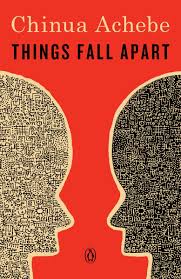
The first book in Chinua Achebe’s “Africa Trilogy,” Things Fall Apart, which was published in 1958, relates the tale of Okonkwo, a legendary warrior who lived in the made-up hamlet of Umuofia in the lower Niger region of Africa. The book is organised into three sections: Okonkwo’s rise and fall in the village is covered in the first, his exile and the arrival of European missionaries are covered in the second, and his return to Umuofia and the battle with the Europeans are covered in the third.Okonkwo is well known in his town as a fierce fighter and wrestler who rose to fame after he defeated Amalinze the Cat, the reigning champion.
Okonkwo holds a firm belief in power, independence, and action, or, to put it another way, masculinity in its most fundamental manifestations, which is appropriate for someone with his unique skill set. This attitude developed in part as a reaction to his father, Unoka, who, despite being well-liked and kind, nonetheless had a lot of debts in the village and was viewed as unable to support himself.In addition, Unoka had a fear of blood and passed away from swelling brought on by an unbalanced diet of which are frowned upon and regarded as feminine in the community. As a result, Okonkwo aspires to establish himself as a respected member of the community. He succeeds in doing so thanks to the kind gift of 1,200 yam seeds from two different village elders, which he receives after his father’s passing leaves him penniless.With the money he receives, he may build a farm, provide for his family, and later, when combined with his physical abilities, start to gain respect in the neighbourhood.Okonkwo is given the duty of taking care of Ikemefuna when he arrives in the community because of his elevated status.
In retaliation for a man in that village killing the wife of a man in Umuofia, a little boy named Ikemefuna was stolen from a nearby village. To replace the man’s wife, a virgin from the village is also offered, preventing a confrontation since Umuofia is much feared by neighbouring clans. Ikemefuna, who at first is terribly homesick, eventually starts to form a relationship with Okonkwo, who in turn has positive feelings toward the boy since he believes like he is more macho than his real son, Nwoye.In order for the village to find a more suitable role for the boy, Okonkwo’s care for Ikemefuna was always only a temporary arrangement. However, they ultimately decide to have him killed. One of the most revered elders in the town, Ogbuefi Ezeudu, informs Okonkwo of this choice and urges him not to “have a hand in his death.” Okonkwo decides to step up and hack the youngster down when the moment comes and the men are marching Ikemefuna out from the town out of fear of being perceived as weak. Okonkwo thinks that he only needs something to do and that if this had occurred during the planting season, he wouldn’t have had these issues after feeling strange for a few days after doing so.
Following this, Ekwefi, Okonkwo’s second wife and the only one who has the audacity to knock on his private quarters door, wakes her husband early one morning by announcing that her daughter, Ezinma, is dying. Ezinma is Okonkwo’s favourite child and Ekwefi’s only child to have lived through infancy, therefore this is especially distressing for her. Since this had previously occurred, they had gone her into the forest with the medicine man to locate and dig up her iyi-uwa, a kind of unique spiritual stone, in attempt to save her. To cure her sickness, they must now give her heating medicine.Okonkwo is later expelled from the clan after his gun accidentally discharges at Ezeudu’s funeral, killing Ezeudu’s 16-year-old son. As a result of the crime being deemed to have been unintended and feminine, Okonkwo and his family’s exile is only to last for seven years. They depart and travel to Okonkwo’s hometown.
Okonkwo travels to his mother’s hamlet of Mbanta for his banishment; he hasn’t been there since he carried his mother home to be buried. He is granted a parcel of land on which to construct his complex as well as land and seeds with which to plant his farm, but despite this, he is still incredibly depressed because his life’s ambition had been to rise to a position of great prominence within his clan, which is now tainted. One of the new clan’s leaders, Uchendu, encourages him not to give up because his penalty is not severe and he is among his kin.The closest friend of Okonkwo from Umuofia, Obierika, visits him in the second year and brings bags of cowries, the native money, that he earned through selling Okonkwo’s yams. Additionally, he informs Okonkwo that a conflict with white settlers had resulted in the eradication of the community of Abame. After that, he goes and doesn’t come back for another two years.
Obierika informs Okonkwo during his subsequent visit that white Christian missionaries have established a church in Umuofia and that some individuals have begun to convert, however none of them are in positions of authority. Obierika was concerned about this in general, but mainly because she had seen Nwoye, Okonkwo’s son, among the converts. The missionaries eventually built a church in Mbanta as well, and they get along well with the community despite their scepticism. Soon after the missionaries arrive in the village, Nwoye encounters his father, Okonkwo, who then threatens to kill his son. Although they are no longer together, Okonkwo believes he was cursed with a daughter-in-law son.Although they are no longer together, Okonkwo believes he was cursed with a daughter-in-law son.
The town convenes a council to discuss what to do about the growing number of Christians led by Mr. Kiaga, a missionary, and to decide what to do about them. Okonkwo pushes for their execution, but the council ultimately decides to simply ostracise them because Mr. Kiaga is regarded as being rather harmless.When Okonkwo finally came to the end of his banishment, he sent money to Obierika to start constructing his new property and hosted a feast for Mbanta to show his appreciation.When Okonkwo returns home, he discovers that his town has altered since the white men arrived. Even more people are becoming Christians, which not only irritates Okonkwo but also causes further tension in the neighbourhood. One day, a convert disrespects a village elder by revealing his identity during a religious ceremony.
As a result, the non-Christians destroy a nearby church in retaliation. In response, the Europeans take Okonkwo and others into custody, beat them, and demanded 200 cowries in fines before releasing them,a messenger then ups this to 250 cowries, planning to keep the additional amount for himself.The inhabitants of Umuofia convene to decide how to move forward after the fine is paid; Okonkwo shows up at this gathering decked out in full military gear. In an effort to mobilise his people, Okonkwo beheads one of the white emissaries who tries to interrupt the meeting. Okonkwo believes that Umuofia has lost its warrior spirit and given up when no one joins him and they let the Europeans to flee.
The Europeans are then invited to help a group of guys at Okonkwo’s compound shortly after they get this request. They move cautiously because they don’t know what to expect, but when they get there, they see that the men need them to remove Okonkwo’s dead body from the tree where he had hanged himself because, according to local custom, suicide is considered a stain on the Earth and cannot be touched or buried with its people. After directing his men to remove the body, the commissioner muses that Okonkwo will make for an intriguing chapter, or at the very least a paragraph, in the book he plans to write about his adventures in Africa, which will be titled “The Pacification of the Primitive Tribes of the Lower Niger.”
Leave a Reply