
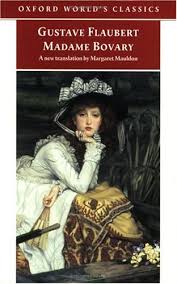
Genre: Realist novel
Publication date: 1856
Author: Gustave Flaubert
Madame Bovary begins with the story of Charles Bovary, a modest and awkward lad who struggles in school before becoming a provincial doctor. Charles’ mother arranges his first marriage to Madame Dubuc, an affluent but unpleasant elderly widow. Their marriage is cut short when Madame Dubuc dies, leaving Charles widowed.
While visiting a patient, Charles meets Emma, a lovely and energetic farmer’s daughter. He falls in love with her and eventually marries her. Emma is initially enthusiastic about the marriage, expecting it to provide her the passion and adventure she has read about in romance books. However, life as Charles’ wife soon disappoints her. They dwell in the quiet village of Tostes, where Charles enjoys his basic routine, but Emma finds it uninteresting and unromantic.
Emma wishes for a more interesting and wealthy lifestyle. Her unhappiness intensifies as she and Charles attend a lavish ball hosted by a wealthy aristocrat. The luxury and elegance she encounters there stokes her longing for money, refinement, and romance. Emma’s return to her boring life in Tostes leaves her restless and sad. She becomes moody and withdraws. Charles relocates them to the small village of Yonville, hoping that a change of scenery will be beneficial.
Emma becomes acquainted with the local pharmacist, Homais, and meets Léon, a young law clerk. Léon shares Emma’s love of art, literature, and music, and their common interests result in a strong emotional bond. Emma develops romantic feelings for Léon, but she attempts to stay true to Charles. Léon, frustrated by the lack of progress in their relationship, departs Yonville to study in Paris, leaving Emma sad.
Emma’s sadness grows until she meets Rodolphe, a wealthy and charming landowner. Rodolphe, a cynical womanizer, regards Emma as an easy acquisition. He seduces her, and the two start a passionate romance. Emma is pleased at first, feeling as if her romantic dreams had finally come true. However, Rodolphe grows tired of her emotional intensity and, after some time, chooses to stop the relationship. On the day of their planned elopement, he writes her a farewell letter. Emma is devastated by the betrayal and slips into a deep depression.
To divert herself, Emma indulges in lavish spending. She purchases expensive clothes, furnishings, and gifts from Lheureux, a devious businessman who encourages her irresponsible conduct. Meanwhile, Charles tries to boost his reputation as a doctor by performing risky surgery on a local guy with a club foot. The treatment goes tragically wrong, and the patient’s limb must be amputated, severely undermining Charles’ professional reputation.
Emma and Charles later visit an opera in Rouen, where she reunites with Léon. This time, she succumbs to her feelings, and they start an affair. Emma lies to Charles, pretending to attend piano lessons in Rouen so she can see Léon in secret. Emma is initially excited by the affair, but it eventually becomes routine and unsatisfying. She becomes disillusioned with Léon, as she was with Rodolphe.
Meanwhile, Emma’s spending has gotten out of control. She gradually borrows more money from Lheureux, who charges astronomical interest rates. Finally, Lheureux demands repayment, threatening to confiscate Charles’ possessions if the loan is not paid. Emma, panicked, searches furiously for money. She turns to Léon, who is unwilling to assist, and even asks Rodolphe, who flatly refuses her.
Emma, in despair, chooses to take her own life. She sneaks inside pharmacist Homais’ laboratory and consumes arsenic. The poison kills her gradually and horribly. Charles is crushed by her loss and unable to cope. He discovers Emma’s love letters from her affairs and is devastated by the reality of her betrayal. Charles dies shortly after, overcome with grief and debt.
Their daughter, Berthe, is left orphaned and impoverished. She is sent to live with a poor relative and ends up working in a cotton mill.
Leave a Reply